Robot architecture
Zig has four brains: one computer that choreographs, and three microcontrollers that each own a body part and keep it safe on their own. This page is the map — every detail lives one click away.
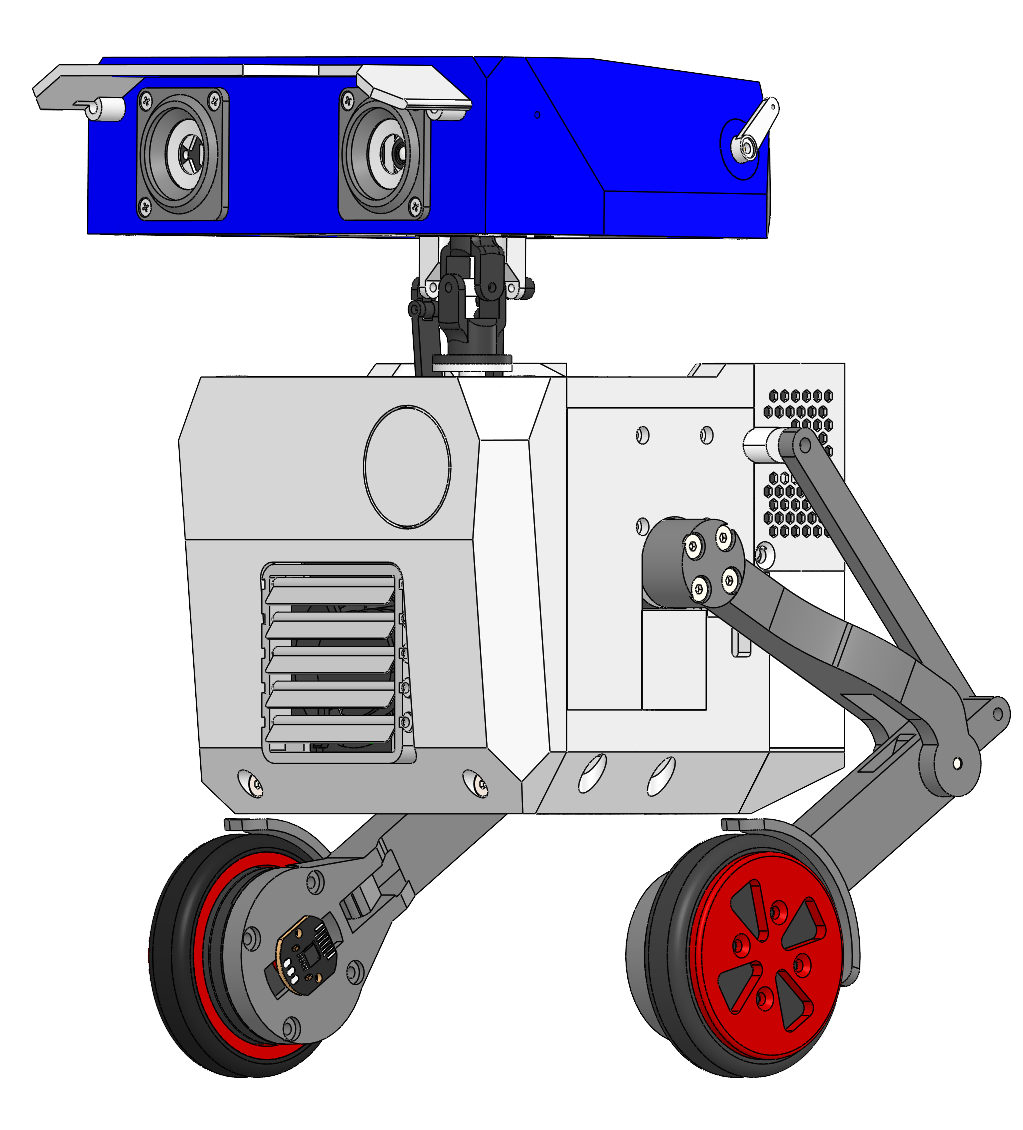 Figure 1: the three body parts of Zig.
The Head is composed of the blue parts and the neck with it's 3 motors in black. The torso is in white with the battery on the back. The legs are composed of the grey parts and the wheels in red and black.
The four brains
| Brain | Part | Role | Why a dedicated brain | Contract |
|---|---|---|---|---|
| Raspberry Pi 5 | Main Computer | choreographer: command arbitration, head trajectories, CoG feedforward, gateway to controller & AI station | needs Linux (network, audio, vision) — therefore never trusted with real-time | System links |
| Pico 2 | Legs & Balance | two-wheel balance, locomotion, leg height | hard real-time control loop; must survive alone if the Pi dies | bus-pi-pico |
| XIAO RP2350 | Head | 3-axis neck + 2 antennas, head sensors | local smoothing of streamed targets; freezes safely on link loss | bus-pi-xiao |
| Nano Every | Torso | power monitoring, fan, LED matrix, torso sensors | slow local automations, isolated from critical loops | bus-pi-nano |
Topology
---
config:
  look: neo
  layout: dagre
---
flowchart TB
    ext["Controller · Station & AI PC"] -.-> pi5["Raspberry Pi 5<br><i>choreographer</i>"]
    pi5 <--> i2c{"I2C bus"}
    i2c <--> xiao["XIAO RP2350 — <br>head<i>local: 5 servos, head sensors and actuators</i>"] & nano["Nano Every — <br>torso<i>local: fan, LED matrix, sensors and power switch</i>"]
    n1["UART bus"] <-- <br> --> pico2["Pico 2 — balance<br><i>local: IMU, 2 encoders,<br>2 BLDC, 2 leg servos, 2 drivers</i>"]
    pi5 --> n1

    n1@{ shape: diam}
    style ext fill:#e6e6e6
    style pi5 fill:#FFD600
    style xiao fill:#FFCDD2
    style nano fill:#E1BEE7
    style pico2 fill:#FFE0B2
linkStyle 4 stroke:#000000,fill:noneFull message maps live in the contract pages; local wiring lives in each part's Electronics page.*
Design principles
The Pi choreographs but never balances: everything time-critical lives in a microcontroller. Every brain is safe alone — each link has a defined loss-of-link behavior, consolidated in Safety & Degraded Modes. Each piece of information has exactly one home: buses are documented once, in their contract page, and everything else links there. Territories follow wiring, not mounting position: a sensor wired to the Pico belongs to Legs even if it is bolted inside the torso.
Going further
Lifecycle & Modes · Motion & Balance · Electronics · Firmware